 For Lots of Rhubarb Recipes and More Get Connected


Food-Drying-Guidelines
How To Dehydrate Certain Foods
Easy to follow food-drying-guidelines and vacuum-packaging for best results will get the most out of a dehydrator.
You will also have an overall picture of the general things to consider when drying most food items for future use.
WHAT AND WHEN TO SELECT
High quality fruit and vegetable produce is best when ripe and at peak season.
REMEMBER TO:
Throughly clean your food items well, and remember to remove the bad spots.
Spread the pieces evenly.
If the items are overlapping on your trays, drying time is cut down considerably.
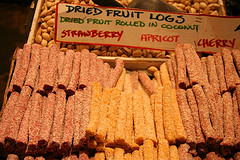
KEY FOOD-DRYING-GUIDELINES
DURING THE FOOD-DEHYDRATION PROCESS
Work quickly while loading trays. You want drying time to be as even as possible for all items at once.
Never turn the machine off mid-stream.
Never leave partially dried food behind. Not only is this bad
for the flavour of the food, it's just plain unsanitary, as
the food can go bad.
Temperatures vary depending upon what you are drying. Fruits
are typically dried at 130F and 140F. The lower the temperature,
the less chance of losing the important vitamins.
Keep the temperature low. Vitamins are sensitive to heat.
TAKE CERTAIN FACTORS INTO CONSIDERATION
Humid conditions can extend drying time.
Thickness of the food items is a factor.
How watery is the fruit or the vegetable?
How much is being dried at one time?
Fruits can be set to a higher temperature to start and then lowered after a few hours. Meats can remain at the higher temperature.
WINDING DOWN
As the dehydration process begins to wind down, keep these food-drying-guidelines in mind to decide if in fact the items are fully dried.
You do not want certain items to be overdried and lose the nutritional value or the taste. Give it a test first.
For fruits, take out a piece and check it for pliability. Is it really soft? Sticky to the touch? Can you see moisture inside it if cut?
If you said to yes to any of these, then you still have more
drying time remaining.
STORING YOUR FOOD ITEMS
Once you have determined that the process is complete, quickly begin to package. Remember, don't leave it lying around for long. Humidity in the air can begin to rehydrate your food and you don't want this.
Have some air-tight containers ready.
Try vacuum-packaging equipment. This is great, and actually increases the shelf-life considerably.
Bag-sealers are also a good choice. You have to get out as
much air as you can yourself manually though before sealing
the bag.
If you think about it, most of these ideas are just a matter of
common-sense. And they can apply to outdoor or oven drying as
well when drying your favorite foods.
Leave Food-Drying-Guidelines, Return To Rhubarb-Candy
Return To Savor The Rhubarb Home Page


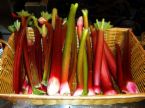

Rhubarb Gin Cocktail
Made it myself! Try one.

New! Comments
Have your say about this topic. Leave me a comment in the box below.