 For Lots of Rhubarb Recipes and More Get Connected


Mysterious Rhubarb-Companions
A Help Or Hindrance In Your Garden?
Do rhubarb-companions such as the brassica family mysteriously help your rhubarb patch? As a rule, do you add specific plantings in with any of your plants with a special role to play in the garden?
Do other closeby plants aid or act as a hindrance to the growth of your rhubarb?
It's all about getting along which is the basis for companion-planting and complimenting the progress of each-other throughout the growing season.
It would seem that certain plants appear to do better when grown near
other plants, and for any variety of reasons. It is apparently not an exact science for all plant combinations either.
When it comes to rhubarb-companions, I can tell you what I have observed in other gardens.
But first of all, the idea behind companion-planting is what benefit does one plant provide that can meet the need for the other to thrive?
For instance, tall flowers that love the sunshine, can provide a source of shade for the smaller ones who don't require as much.
It has been suggested that small rhubarb-companions can benefit from the shade, but be protected from the winds and other harsh elements as well.
Regarding moisture and nutrients, some plants literally soak up as
much as possible from the soil, whereas other plants only need a
small portion of nutrition or require a drier area anyway to sustain themselves.
If two different plants were competing heavily for the same resources, they could both wind up the losers if too close together in one area.
Therefore, they may not make good plant companions.
Some plants will return nutrients such as nitrogen to the soil.
In fact, they may return more than they take, which in turn will
benefit "the others" around them.
By harvesting plants that have quickly matured early in the season, you will have created room for a row of another plant that grows at a much slower rate beside it.
This and some of the earlier theories behind companion-planting make use of much smaller spaces when planning your garden.
The planting of specific plants near each-other can simply be for the purpose of visual beauty by arranging various colors and heights. Some people say that one plant can enhance the flavor of another.
And then there are the insects.
This is where rhubarb-companions come in handy.
Companion-planting uses the theory that certain plants will attract
specific insects, thus luring them away from other plants, like your prized vegetable bed for example. The "bait" plant is referred to as the "trap-crop", which is discarded from time to time. The prized vegetable bed remains protected.
Garlic and onions are good rhubarb-companions through smell, as they do the opposite, but to the same outcome. They repel aphids which love to get at the rhubarb. Sweet peppers act in the same way.
In turn, rhubarb is a good friend to columbine flowers, as it repels spider mites.
Rhubarb protects beans against black fly infestation.
Other good rhubarb pals are members of the brassica-family.
This family includes kale, cabbage, broccoli and cauliflower.
They seem to do very well near a rhubarb patch, though I have not
heard a specific reason why. It may have something to do with the
acid in the rhubarb root, but no-one seems quite sure.
Visit the
Organic Veggie Patch
for more extensive information on companion planting.
So what makes a good rhubarb plant friend? Does the rhubarb need
protecting, or is the rhubarb actually the protector? It's a little bit of both I guess.
I have in fact seen a huge row of rhubarb planted at the back of a garden, with rows of tomatoes, cucumbers and beans fairly close in front. Neither seemed affected by the presence of the other two. I believe there were raspberries nearby as well.
The garden produced well, and we ate from that garden every year. It was wonderful.
The only complaint I actually heard was about the slugs which
were in the rhubarb. I think in that instance, toads would have made good rhubarb-companions.
Speaking of slugs, there are some great methods you can use to help rid your garden of them.
Rhubarb can play other roles in your garden as well. Not only is it grown for food, acts as a protector to other plants, but it can just add to your garden landscape simply from the natural beauty of the various species.
See different types of ornamental rhubarb and you may decide they have a place in your garden as well.
Other rhubarb look-alikes act in the same way rhubarb does as a companion in the garden.
Giant Rhubarb
is one such species. Think you have room for THIS one?
Leave Rhubarb-Companions
Return To Savor The Rhubarb Home Page


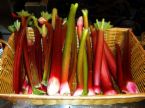
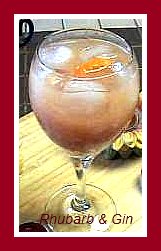
Rhubarb Gin Cocktail
Made it myself! Try one.

New! Comments
Have your say about this topic. Leave me a comment in the box below.