 For Lots of Rhubarb Recipes and More Get Connected


The Rules That Govern
Quality-Controlled-Rhubarb
How quality-controlled-rhubarb must meet certain standards of trade-policy is firm.
Ever thought about the specifics of how rhubarb quality is monitored? I never have, but I was given some interesting reading on the subject.
Certain standards and rules govern rhubarb just like any other vegetable when it
comes to international trade-policy for produce. It is interesting to note
how and what requirements must be met at export.
How is this even decided?
The UNECE, or "United Nations Economic Commission for Europe" is a part of the United Nations that sets policy development and standards to follow. Well over 50 countries worldwide take part in the forum provided by the UNECE to gather and exchange ideas on quite a number of topics related to economic issues such as the environment, energy, trade and so on.
The UNECE offers assistance in the way of workshops, seminars, advisory
services, and also in a technical capacity by their own experts.
For trade-policy purposes, quality-controlled-rhubarb is defined
as leaf stalks grown from "Rheum rhaponticum L." and supplied
to the consumers as fresh.
Typically, the rhubarb is classified either as Class 1 or Class 2.
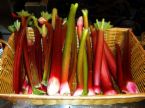
Generally, Class 1 rhubarb must be of a good quality. Regarding the mode-of-cultivation, it must possess the characteristics of that specific variety. The stalks must be well developed.
Forced rhubarb must be deep pink or red in color for a minimum of
2/3 of the stalk. The stalk must be straight and have no bud
sheaths. If there is any leaf blade, it must not be damaged
Rhubarb in Class 2 includes rhubarb that does not qualify for
Class 1, but at the same time meets minimal requirements with
some allowances for slight defects, as long as the rhubarb
exhibits their particular important characteristics.
There are overall minimum requirements that are subject to
certain provisions depending on the class and the level of
intolerances allowed.
MINIMUM REQUIREMENTS TO MEET QUALITY-CONTROLLED-RHUBARB STANDARDS
Stalks in one piece
No rotting or deterioration
clean
pest-free
no visible pest damage
fresh
smooth
mostly unbruised
has to have specific color related to mode-of-cultivation
no abnormal moisture on the outside
no foreign smell or taste
able to withstand transport
arrive in good condition
If the rhubarb has been grown in a forcing shed, there may be a leaf blade present.
If the rhubarb was grown any other way, the leaf blade must
be neatly cut 5 cm. from the top of the stalk and no more.
Size of the stalks are factors and measured by length
and diameter dependent upon where they came from.
For example, these measurements depend on whether or not
the rhubarb came from a forcing shed, was grown in the open,
or was grown in the open, but not forced.
There are 10% intolerances allowed in Class 1 and 2 regarding
quality and size for rhubarb that does not meet the complete
requirements overall that are packaged or in an unpackaged
bundle.
What is not allowed, is deterioration of the product that
renders it unfit for human consumption.
Quality-controlled-rhubarb must meet packaging standards as well.
The produce has to be protected properly by materials that are clean, new, and of good quality. Labelling has to done with glue or non-toxic ink.
There cannot be any foreign substances all over the bundles.
Rhubarb must be packaged in neat rows.
Uniform Variety (not mixed types in one bundle)
Produce must be clearly marked if not visible as to type.
All proper identification must be visible as well
in regard to origin of the produce. This would
include things like the country, the variety,
shipper, packager, weight and any other particulars
from this category.
It's good to know that there are organizations that keep a
watchful eye on the foods that are presented to us as consumers.
If you would like to read more about the UNECE and the good
works that they are involved in, you can visit them here.
The UNECE
Return To Rhubarb Trivia
Leave Quality-Controlled-Rhubarb, Return To Savor The Rhubarb Home Page


POPULAR READS
Starbucks
Rhubarb Tanning Agent
Worm Composting
National Pie Day
Slug Catcher
Quality Controlled Rhubarb
Prairie Home Companion
A Game For the little Chefs
and Bakers in the family.
The Rhubarb Pie Game - Cool!


New! Comments
Have your say about this topic. Leave me a comment in the box below.